Software
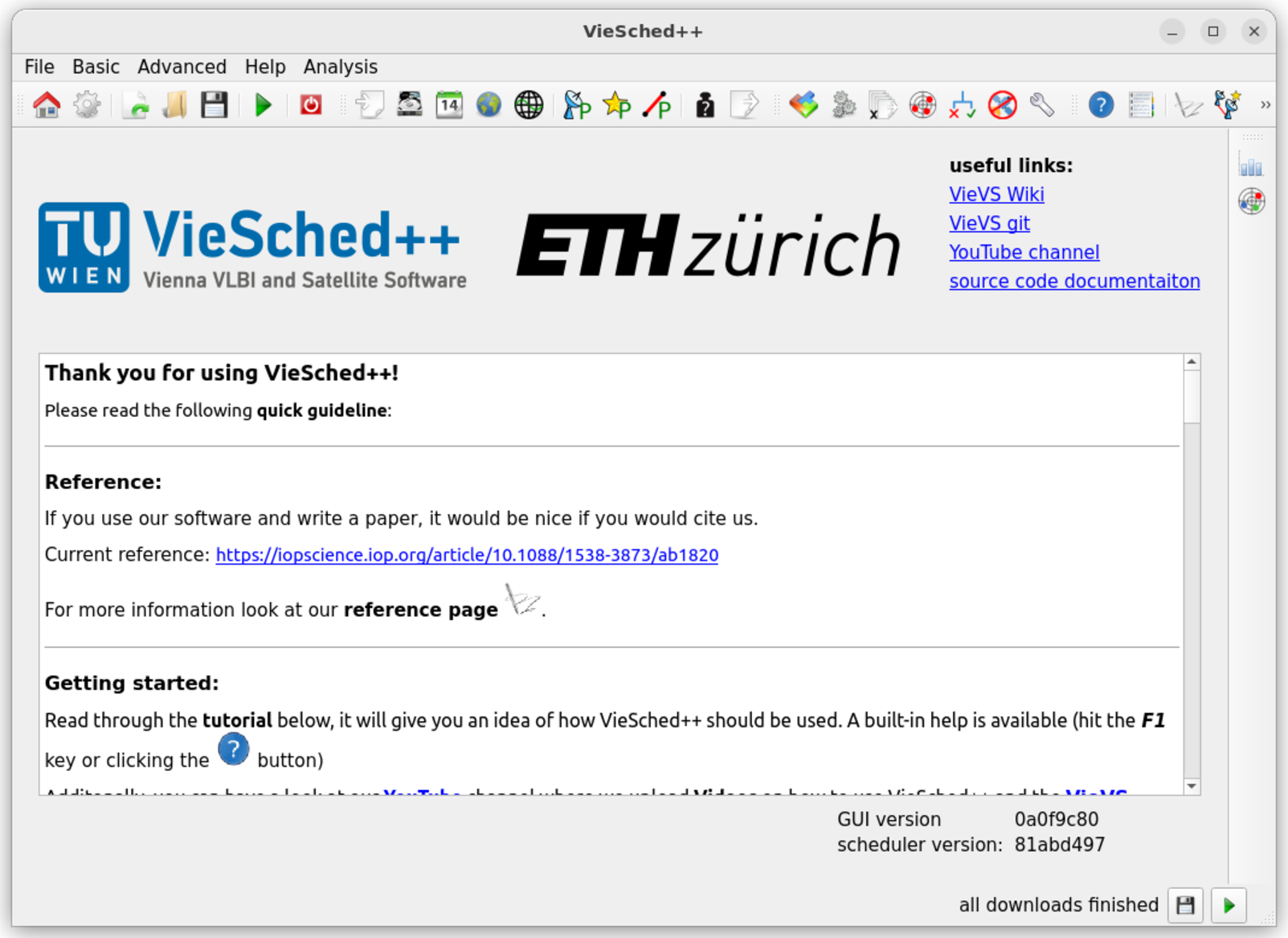
external page VieSched++ is a VLBI scheduling and simulation software, widely used in the IVS community. The software can be operated through a external page GUI, in batch mode via an XML input file, or fully automatically via a external page python framework. It comes with sophisticated algorithms for SX and VGOS 24-hour and Intensive sessions to generate schedules of highest quality.
The software is avaliable at: external page https://github.com/TUW-VieVS/VieSchedpp
Reference:
Schartner, M. and Böhm, J. (2019). VieSched++: a new VLBI scheduling software for geodesy and astrometry. Publications of the Astronomical Society of the Pacific, 131(1002), 084501. doi: external page 10.1088/1538-3873/ab1820

GNSS engine dedicated to the processing of diverse GNSS observations covering data collected with both low-cost devices and smartphones. The core of the software forms RTKLIB ver. 2.4.3 b34. The engine has been complemented with IAU SOFA routines and extended with additional useful features such as multi-GNSS support, SINEX interface, or VTEC extraction based on the carrier-to-code levelling. Parameter estimation in CamaliotGNSS is performed with the use of an extended Kalman Filter (EKF) where the target and nuisance parameters are expressed as EKF states (epoch-wise state vectors and covariance matrices). In the case of post-processing, the parameter estimation is possible with either a forward-in-time filter, a backward-in-time filter, or via the combined solution leveraging both forward and backward filter solutions.
Software Routines from the IAU SOFA Collection were used. Copyright International Astronomical Union Standards of Fundamental Astronomy (external page http://www.iausofa.org).
Reference:
- Kłopotek, G., Soja, B., Crocetti, L., Awadaljeed, M., Pan, Y., Rothacher, M., See, L., Weinacker, R., Sturn, T., McCallum, I., and Navarro, V. (2022). Exploring Crowdsourced GNSS Observations for Data Fusion with the Use of Machine Learning. 8th International Colloquium on Scientific and Fundamental Aspects of GNSS. Sofia, Bulgaria, September 14–16, doi: external page 10.3929/ethz-b-000571141.
VLBIono is a Python-based software tool dedicated to the estimation of Vertical Total Electron Content (VTEC) from diverse Very Long Baseline Interferometry (VLBI) observations, covering data collected with both SX and VGOS systems for 24-hour sessions.
The core of the software forms a custom Python implementation of a least squares algorithm. The tool has been complemented with routines for robust outlier detection and weighting strategies, and extended with additional useful features such as integration with external TEC data sources (e.g., GIMs and Madrigal for comparison), instrumental offset estimation, and automated plotting for bias and correlation analysis. VTEC estimation in VLBIono is performed using least squares adjustment, where parameters are solved epoch-wise for each station, incorporating session-specific models and filtering.
In the evaluation mode, results are processed to compute biases, standard deviations, and RMS values, with support for colocated station comparisons and long-term time series analysis.
The codebase is available at: https://gitlab.ethz.ch/spacegeodesy_public/vlbiono
Reference:
Rüegg, A., Kłopotek, G., & Soja, B. (2025). A Comparative Study of VTEC Estimates Derived from S/X VLBI and VGOS Observations. ESS Open Archive. external page https://doi.org/10.22541/essoar.174802866.69330893/v1